
The MARCOS Screening:Why Injuries, Not Fitness, Decide Who Makes It
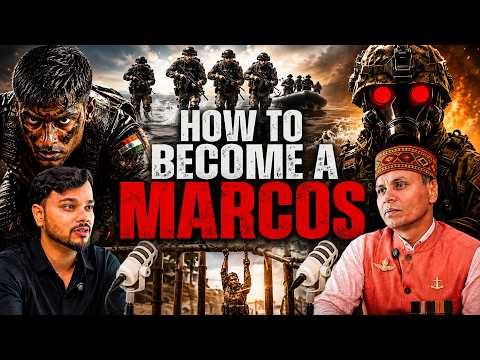
In 2003, Praveen Teotia was a survey recorder on an Indian Navy ship.
His job was routine: sailing duty, recording survey data, the kind of steady, structured life the Navy is known for. He had no plan to become anything else.
Then a MARCOS commando reported aboard.
A Chance Meeting That Changed Everything
Teotia was the one who took his report. He noticed the badges, the maroon cap, the bearing of someone clearly built differently. Curiosity got the better of him, and he started asking questions.
What is this? How did you get here? What kind of operations do you do? What are the facilities like?
The commando answered everything, and something in Teotia shifted. He started feeling, in his own words, that this was his line.
That he was doing the wrong thing on that ship. The next morning, almost on impulse, the two of them went for a run together.
Then they moved to the battle obstacle course. Teotia performed well enough that the commando himself was surprised, and asked him directly: what are you doing on a ship, man?
That question stayed with him. Within two years of survey duty, from 2003 to 2005, the decision was made. He was going to become a MARCOS.
The Long Road In
Deciding to become a MARCOS is only the beginning. The process starts with permissions from within the Navy. Once cleared, candidates sit an aptitude test.
Only after passing that does the actual course begin, and it starts with numbers that are almost hard to imagine surviving: 120 to 140 candidates arrive together for a single course.
From there, the filtering starts immediately. A two-week screening process determines who continues and who doesn't. Whoever survives that screening moves forward into ship diving or clearance diving training.
Only after clearing that stage does a candidate actually get sent to MARCOS training itself.
In other words, by the time someone reaches the point most people would consider "MARCOS training," they've already been through multiple rounds of elimination.
The course itself is the reward for surviving everything that came before it.
Inside the Two-Week Screening
The MARCOS screening, Teotia explains, is unlike any other. It's built around weight, endurance, and repetition rather than any single test of skill.
Candidates go through the battle obstacle course carrying real load: a 5-kilogram backpack called a pittu, a water bottle, and an issued rifle that stays with them constantly. Long runs happen with all of this gear strapped on.
There's no putting it down. Candidates carry it with them all day, moving from one training block to another, for the full two weeks of screening.
Partway through, something small but significant changes: the footwear. Sports shoes, with their built-in cushioning, are swapped for jungle boots.
This isn't a minor adjustment. Sports shoes are designed to absorb impact. Jungle boots are not.
As Teotia describes it, when you're wearing sports shoes, the cushioning does the work for you. Jungle boots strip that away entirely.
The reasoning behind this design is deliberate, not accidental. Jungle boots aren't built for roads or the kind of smooth, predictable surfaces that running shoes handle well.
They're built for terrain, for jungle conditions, for trekking through unpredictable ground. Comfort was never the design goal. Functionality in the field was.
The tradeoff, though, is significant. Without cushioning, the foot strikes the ground directly, almost as if there's nothing between you and the surface. That translates into a sharp rise in injuries. Running, physical training, the BPT tests, all of it continues to happen in these boots, and the body absorbs far more impact than it would in standard training footwear.
Why Injuries, Not Fitness, Decide Who Makes It
Here's the detail that reframes the entire selection process: there's no fixed quota. Teotia is clear about this.
There was no set number of seats when he went through it, and even today, the constraint isn't really about how many people can be accepted. It's about how many people can survive the physical toll without breaking down.
Today, roughly 30 to 35 candidates make it into each batch, with two batches commissioned per year, bringing the total to around 60-70 new MARCOS commandos annually.
That number has crept up slightly in recent years simply because more strength is needed across the force. But in Teotia's time, the structure was even looser: whoever could hold on and keep performing was in.
No fixed count, no artificial cap. Just endurance against attrition.
The single biggest factor determining who doesn't make it is not a lack of raw ability. It's injury.
Once a candidate is injured during the course, Teotia says, coming back and completing the training becomes extremely difficult.
The body simply doesn't get the recovery time the process demands. Space stays open for whoever is efficient, whoever hasn't broken down, whoever is still delivering. It's less a competition against other candidates and more a race against your own body's ability to hold up under sustained, repeated load.
The Bigger Lesson
There's something worth sitting with here beyond the specifics of commando training. In most high-stakes selection environments, whether it's an elite military unit or a demanding career path, raw talent gets you to the starting line.
It gets you noticed, gets you an aptitude test, gets you into the room. But it's rarely what determines who actually finishes.
What determines that is durability. The capacity to keep performing under repeated, compounding stress, without your body or your resolve giving out. Teotia's story is, at its core, a story about a chance encounter that redirected an entire career.
But the mechanics of how MARCOS selection actually works reveal something more universal: in any environment built to filter for the best, survival often has less to do with who is most gifted, and more to do with who can protect their edge long enough to use it.
What's the toughest selection or filtering process you've experienced or heard of? Share it in the comments below.
Watch Full Conversation:
More from the blog



Subscribe to our newsletter
The best new roles, resources and must-watch episodes — in your inbox every week. No spam, unsubscribe anytime.
