
Officer vs Jawan Pay Gap: MARCOS Commando Exposes Army Discrimination
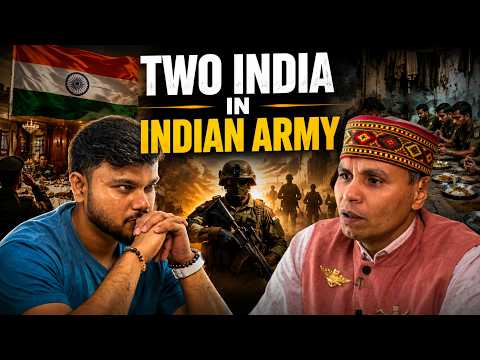
Praveen Teotia has earned the Surya Chakra, one of India's highest peacetime gallantry awards.
He served as a MARCOS commando, was present during the 26/11 Mumbai attacks, and has completed the Khardungla Challenge, one of the most demanding endurance tests in the country.
When he talks about discrimination inside the Indian Armed Forces, he isn't speaking as an outsider with a grievance.
He's speaking as someone who has bled for the institution he's now criticizing.
His argument starts from a simple premise.
A jawan and an officer, standing in the same unit, facing the same enemy, are not compensated the same way, even when the danger they face is identical.
The Pay Structure Gap
Praveen walks through several categories where this plays out. Military Service Pay differs by rank.
Siachen allowance, paid to soldiers enduring one of the most hostile environments on earth, is higher for officers than for jawans doing the same posting.
Special forces allowance, which Praveen has personal experience with as a Marcos, is also rank-differentiated, despite both officer and jawan completing the same brutal selection course.
Submariners face an identical split.
He's explicit that he isn't arguing base pay or qualification-linked pay should be equalized.
Different training pipelines, different entry routes, and different responsibilities can reasonably justify some differences. His objection is narrower.
Battle Casualty Pension: The Sharpest Example
The clearest illustration Praveen gives is battle casualty pension, the compensation paid to soldiers wounded in active combat.
He describes a scenario where a jawan and an officer sustain comparable injuries in the same engagement.
The officer's battle casualty pension can land between eighty and ninety thousand rupees a month.
The jawan's, for a similar category of wound, can be as low as ten thousand.
His question is direct: if the wound is the same, why is the compensation for that wound different?
He isn't asking for the officer's pension to be reduced.
He's asking why the jawan's isn't closer to matching it, when the injury sustained in service of the country was identical.
Life Inside the Wire
The discrimination Praveen describes isn't confined to pay slips. Mess halls, he says, are segregated by rank.
Officers eat in one style, often described as more Western in format.
JCOs eat differently. Jawans and other ranks frequently eat outside the mess entirely, because indoor space isn't built to accommodate everyone at once.
Even breakfast, he notes, often happens outdoors for the lower ranks, while the higher ranks eat indoors.
Club access follows a similar pattern.
Praveen says jawans have effectively never been granted membership to the clubs officers have access to, describing it as a rule made by people at the top, for people at the top.
One Place Where the Line Doesn't Apply
Praveen offers a notable exception to the pattern he's describing: caste.
Unlike many Indian institutions, he says the forces don't discriminate along caste lines.
Everyone in uniform is treated as belonging to a single category, soldier.
It's a detail he raises almost as relief, an acknowledgment that at least one axis of discrimination common elsewhere in the country doesn't show up here.
Honorary Ranks and Misplaced Heroes
The most pointed section of the conversation concerns honorary military rank.
Praveen points out that the forces have granted honorary ranks to cricketers such as MS Dhoni, Kapil Dev, and Sachin Tendulkar, while living recipients of the Param Vir Chakra, India's highest gallantry award, have not received equivalent honorary recognition.
He asks a fair question: if the forces are choosing whom to elevate as heroes, shouldn't that list start with people who were actually heroic in combat, not in a stadium?
He follows this with a personal example.
A course-mate who won a shooting gold at the Commonwealth Games was fast-tracked to JCO rank around the same time.
Praveen's own promotion, earned through direct combat exposure and a serious injury sustained protecting others, was, in his account, held up.
He frames the contrast bluntly: one soldier fired at paper targets and was promoted quickly; he fired at a live enemy, was wounded, and waited.
What He's Actually Asking For
Praveen's core argument isn't a demand to dismantle rank structures or flatten the hierarchy that any military needs to function.
It's narrower and, in some ways, harder to argue against: when the risk is equal, when the wound is equal, when the blood shed is equal, the recognition and compensation for that specific sacrifice should be equal too.
Whether that argument holds up against the institutional logic that produced the current system is a separate question.
But hearing it from someone who has lived through combat, carries the physical cost of it, and still chose to speak publicly about the imbalance, is a different experience than reading about defence pay scales in a policy brief.
Watch full Conversation-
More from the blog


Subscribe to our newsletter
The best new roles, resources and must-watch episodes — in your inbox every week. No spam, unsubscribe anytime.
