
Why the Indian Army Honours Dead Soldiers But Punishes Injured Ones
There is a particular kind of silence that surrounds soldiers who survive their injuries.
The country has no shortage of rituals for those who die in service - the statues, the gun salutes, the village gates named in their honour.
But for the ones who live, and live with a disability earned in the same uniform, doing the same duty, there is often no ritual at all.
There is, instead, a file. A recovery notice. A quiet removal from the list of people the system considers useful.
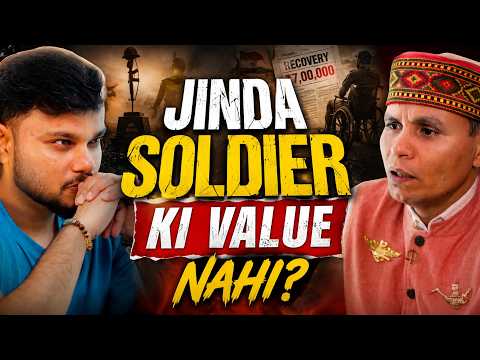
MARCOS commando Praveen Teotia shared a case on Accompany Akki that makes this distinction painfully concrete.
It involves two commandos, one operation, and two outcomes that could not be further apart.
This is not a hypothetical scenario. Praveen says he is personally following this case and is actively opposing how it has been handled.
The Jump That Changed Everything
Two MARCOS operators carried out a free fall parachute jump during the same operation. Something went wrong mid-jump.
One commando died on impact.
The other survived, but with severe damage to his back that would end his career in the role he had trained for.
What happened to each man afterward tells you almost everything about how a highly disciplined, mission-first institution like the armed forces separates the value of dying in service from the value of surviving it.
What the Martyred Soldier Received
The soldier who died was brought home to his village with full military honours.
The crowd chanted the familiar refrain about his memory living on as long as the sun and moon endure.
A marble statue was erected in his honour in his village. His unit installed a bronze memorial on base. The village built a gate and named it after him.
Beyond the official channels, his fellow MARCOS commandos personally contributed somewhere between 25 and 30 lakh rupees for his family - an act of brotherhood on top of whatever official compensation the military provided.
His family also became eligible for family pension, which continues based on his service record at the time of his death.
In death, both the institution and his brothers in arms moved quickly, and moved generously.
What the Surviving Soldier Received
The other commando, the one who lived, was declared a Battle Casualty.
On paper, that designation sounds like recognition.
In practice, it triggered the opposite outcome.
Because his back injury left him unfit for the physical demands of MARCOS-level operations, he was de-inducted - formally removed from the cadre he had trained for years to join.
Then came the part Praveen describes as almost impossible to justify: the military began recovering the Marcos allowance he had received during the roughly two and a half years between the day of his injury and the day of his formal removal from the cadre.
That recovery totals close to 7 lakh rupees, and it is being deducted directly from his ongoing monthly salary of 25,000 to 35,000 rupees.
On top of the base allowance, MARCOS commandos also receive a separate diving allowance for underwater operational work.
Since his injury means he can no longer dive, he has lost that income as well.
Praveen estimates the total monthly financial damage - lost allowance combined with lost diving pay - at around 40,000 to 45,000 rupees a month.
That is a significant cut for a soldier who is still, technically, serving his country in uniform.
There is no special provision protecting him from this recovery.
According to Praveen, the only route available to him is to formally challenge the order through higher military authorities or in court.
Until that challenge succeeds, if it ever does, the monthly deductions continue.
The Pension Gap Nobody Talks About
The disparity does not end with the recovery notice. It extends into long-term financial security as well.
The martyred soldier's family receives family pension immediately, tied permanently to his service record at the time of death.
The injured soldier, still alive and still nominally in service, has no equivalent safety net.
Since he has not completed his full term of service, he is not yet pension-eligible - even though his injury has already ended the specialised career he trained for.
In effect, the soldier who survived is worse off financially, in the near term, than the family of the soldier who did not.
Two Soldiers, One Institution, Two Completely Different Values
Praveen's argument is not that the martyred soldier's family was honoured too generously.
It is that the surviving, injured soldier should not have received so much less than the ceremony and support extended to his fallen comrade.
Both men were part of the same operation. Both accepted the same level of risk in service of the same country.
One is remembered permanently with a statue, a memorial, and a fund raised by his own unit. The other is treated as a financial liability who effectively owes the military money for having survived.
Praveen frames the underlying tension clearly: honouring someone after death costs an institution very little beyond ceremony and public goodwill.
Supporting someone who survives an injury costs real money, long-term commitment, and structural flexibility - and that is exactly where the system appears to fall short, not just in this case but as a pattern.
Why This Case Matters Beyond the Armed Forces
It would be easy to read this story as a military-specific issue, a quirk of defence administration.
But the underlying pattern - it is cheaper and easier for an institution to honour a symbolic loss than to sustain real support for an injured survivor - shows up far beyond the forces. Insurance disputes, workplace disability claims, and long-term care systems all show versions of the same imbalance: sudden, visible tragedy gets fast, generous response; ongoing, less visible need gets bureaucracy and clawbacks.
What makes the MARCOS case unusually stark is the direct, side-by-side comparison. Same operation. Same unit. Same risk.
The only variable that determined honour versus penalty was whether the soldier lived or died.
A Question With No Easy Answer
Praveen is not speaking in the abstract. He says he is personally following this exact case and is vocal about opposing the recovery being imposed on the injured commando.
His frustration is less about any single policy clause and more about what it signals: if you die, you become a hero, permanently and publicly.
If you survive with a disability, you become an administrative liability to be quietly managed off the books.
The question Praveen leaves unanswered - because there isn't a clean answer - is how the same cadre, within the same institution, can treat two men who took on identical risk in an identical operation so differently, based entirely on whether they lived or died.
There is no tidy resolution here. The recovery order stands unless it is formally challenged and overturned.
The statue stands too. Both are permanent fixtures of the same system - one built in marble and bronze, the other written into a monthly salary slip as a deduction.
Watch the Full Conversation-
More from the blog

Subscribe to our newsletter
The best new roles, resources and must-watch episodes — in your inbox every week. No spam, unsubscribe anytime.
