
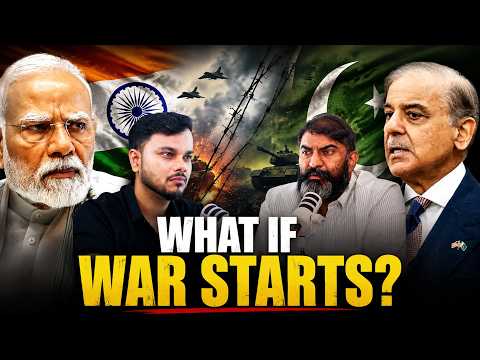
How Pakistan's Military Turned Terrorism Into a Business Model: Samar Toor Explains

There is a version of Pakistan's military history that gets repeated so often it starts to feel like background noise.
Then there is the version Samar Toor lays out in this conversation, detailed, documented, and far more disturbing than most people realize.
A Double Game Decades in the Making
It starts with a simple but damning fact. Pakistan sheltered Osama bin Laden for years while running the Haqqani network as an active tool of state policy, all while presenting itself to the world as a US ally.
This was not an accident or an intelligence failure.
It was a calculated double game, one that had been in the works since the late 1970s when the Soviet invasion of Afghanistan gave Pakistan the opening to raise the Mujahideen and position itself as the frontline state in the fight against the Soviets and later the Northern Alliance.
By the 1980s, Pakistan had shifted its playbook closer to home.
Contrary to popular belief, terrorism was not first introduced in Kashmir.
It began in Punjab, where Khalistani separatists were armed and funded to launch an insurgency.
That template, arm a separatist movement, fund it quietly, and let it destabilize a region, was refined in Punjab before it was exported east.
By 1989, the same approach had given rise to the JKLF in Kashmir, with figures like Yasin Malik beginning a new chapter of violence in the Valley.
The Balochistan Genocide
The most disturbing part of this conversation is what has happened in Balochistan. Since 1999, Samar describes what can only be called a systematic genocide.
Political leaders have been assassinated. Ordinary people have disappeared without a trace, with entire generations of families wiped out.
And in a particularly calculated move, historians have been targeted and killed, along with the deliberate burning of books documenting Baloch history.
The logic is simple and brutal. If you erase the historians and the historical record, a tribe loses any evidentiary basis for its own identity and claims.
It is a strategy with uncomfortable echoes of empires past, and it has been running largely unnoticed by the outside world for over two decades.
The Legal History of PoJK
This history connects directly to the legal status of Pakistan occupied Jammu and Kashmir.
On October 26, 1947, Maharaja Hari Singh signed the Instrument of Accession, legally joining the entire region, from Gilgit Baltistan down through Poonch and Rajouri, to India.
This was a legally binding document. When Nehru later sought UN intervention, a ceasefire was called, and the line where Pakistan's army had reached became what we now know as the Line of Control. Under that original UN framework, Pakistan's military should have vacated the territory it held. It never did.
What makes this moment different is that the people living under Pakistan's control in PoJK are now speaking up themselves. Decades of neglect, stolen electricity, stolen minerals, no medical infrastructure, no road connectivity, no public toilets, and a tourism sector left to collapse, have pushed the local population to openly criticize the very military that claims to protect them.
Islamabad's recent move to declare PoJK a temporary province, a "suba," has only intensified the resentment. As Samar puts it, this is not azad or free Kashmir.
It is a region kept deliberately enslaved, and now the population is refusing to stay quiet about it.
Terrorism as a Structured Business
Perhaps the most eye opening part of the conversation is how all of this is funded. Terrorism, in Samar's telling, is not just an ideology for Pakistan's military establishment. It is a business.
Terror recruits from PoJK go through structured training levels, from basic "daura e aam" to advanced "daura e khaas," with specific tracks for explosives, small arms, intelligence, and command roles. It is an organized operation with clear verticals, built to sustain a rogue state apparatus indefinitely.
The Narco Trade Connection
The funding behind this system traces back to narco trade. Regions like Tirah Valley and several others operate under standard operating procedures that allocate poppy field quotas to different terror outfits as part of their operational responsibility.
The hashish extracted is weighed weekly and smuggled out through Iranian trade routes in exchange for dollars.
Pakistan's military, according to Samar, is heavily dependent on this narco economy. The recent arrest of a woman known as Pinky, described as a central figure coordinating drug cartel distribution networks, sent shockwaves through Pakistan's political and military circles precisely because of how deeply embedded she was in this financial pipeline.
And now, crypto has added a new, harder to trace layer to how this money moves.
A System Collapsing From Within
What emerges from this conversation is not a simple geopolitical rivalry. It is a picture of a state apparatus that has built genocide, terrorism, and narco trafficking into its operating model, and is now watching that model collapse from within as its own people run out of patience.
Full Conversation:
More from the blog


Subscribe to our newsletter
The best new roles, resources and must-watch episodes — in your inbox every week. No spam, unsubscribe anytime.
